Showing posts with label Busan. Show all posts

Monday, April 4, 2011

Baseball Season Begins

Aaron's panorama of the stadium.  
Saturday was the opening day for baseball in Korea and we were so excited! We went to the Lotte Giants' (our local team) game and enjoyed cheering, chicken and a fantastic baseball game (we won 6-0). Here's a taste of why we love going to these games so much (aside from the fact you can bring your own food and beverages into the stadium).  This is in the 5th inning.


Busan has the GREATEST fans in the world. People make pom pons out of newspaper and put plastic Lotte bags on their heads to show their team spirit.  And there's a cheer for every player and EVERYONE in the stadium knows them. This one's for Kang Min Ho.


Sunday, October 24, 2010

Paul and Mary do Korea!

On a cruise off the coast of Busan.
What a fantastic past few weeks we've had!  The highlight---a two week visit from my parents!  The two weeks were packed with visiting my school, a trip to Seoul, viewing North Korea and visiting the DMZ, eating all kinds of raw (and sometimes still squiggling) seafood, and hiking in the beautiful mountains. 

After 2 delayed planes, a missed flight, and a night in Tokyo, Japan, my parents made it to Korea!  My school was kind enough to let me skip out on a few classes so I could meet them at the airport. Upon arrival, I rushed them to the apartment to drop off their stuff and then, after only 2 hours in Korea, they ended up in the principal's office.  But rest assured it was on a positive note.  He greeted them with tea, and true Korean generosity, offering them anything and everything they said was "beautiful" or "interesting" including a wooden tea table and teapot.  My dad kindly declined at the time, but little did he know...

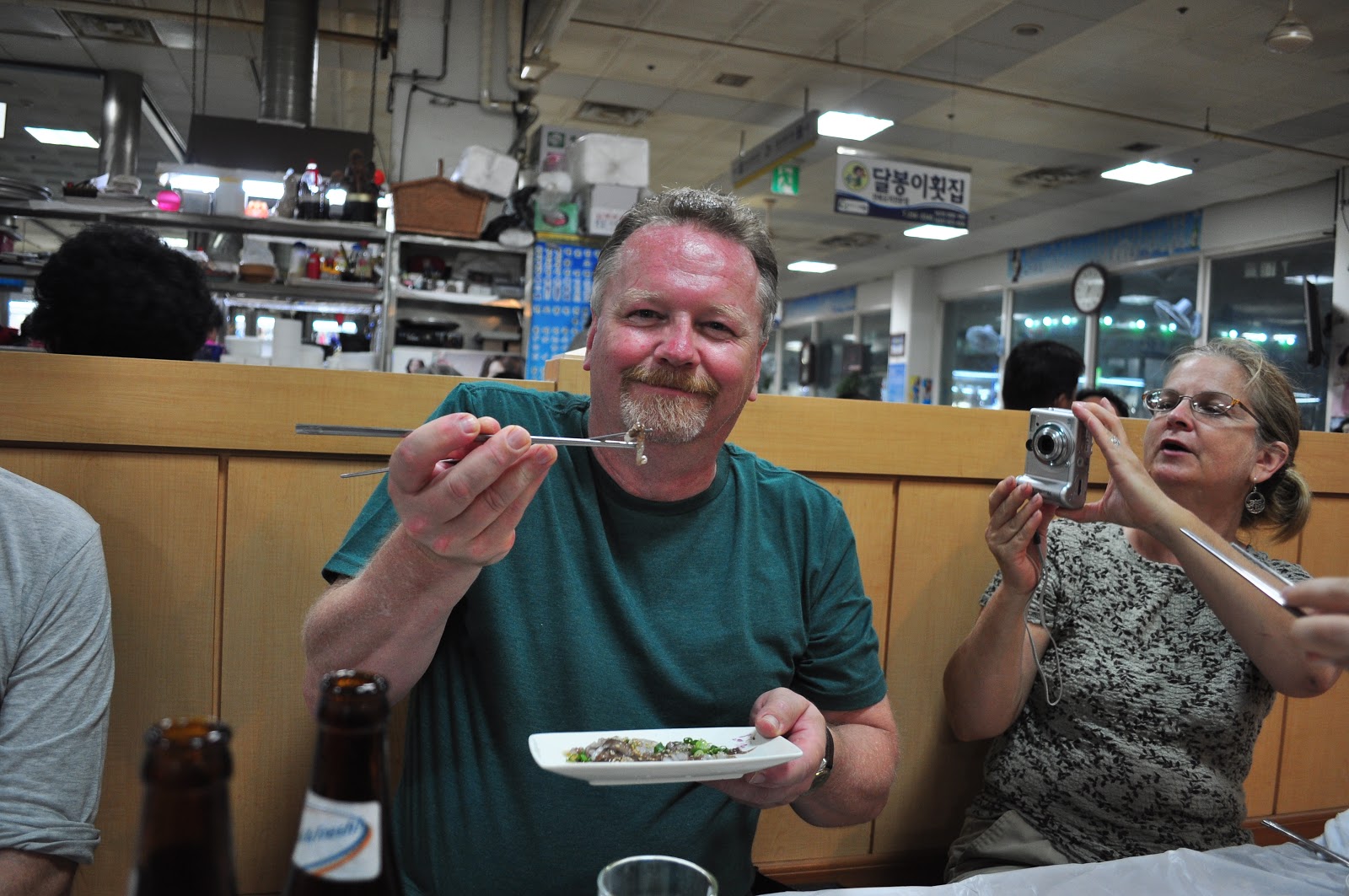
The next day we went to the ocean and Jalgalchi Market, an "aquarium" in which you can choose your dinner from a tank and have it ready on a table within 10 minutes!  My dad bravely ate the still squiggling octopus.
No fear!!
Aaron and I were lucky enough to have 4 days off of school for Chuseok, Korea's version of Thanksgiving.  Many things were closed for those few days so we headed to our favorite temple in the mountains.  We also ate at a very traditional Korean restaurant on Chuseok and both my parents tried and spat out silkworm larvae as well as dozens of fermented vegetables (which they enjoyed a bit more than the silkworms).  


The beautiful rice paddy fields behind Tondo Temple.
At Tongdo Temple.
Mom being interviewed by some English students at Insadong Market in Seoul.
Our next adventure was to Seoul and to the DMZ (Demilitarized Zone).  Going to the DMZ was something Aaron and I have wanted to do since we arrived in Korea.  We went on a tour through the USO (the United Services Organization). The border between North and South Korea is the heaviest guarded border between any two countries.  Perhaps the most startling thing about the tour was realizing how close the DMZ is to the second largest metropolitan area in the world. It took us a mere 45 minutes to get to the border from downtown Seoul.  


Standing beside a South Korean soldier in the Military Armistice Commission building.  This is where joint meetings have been held for the observation of the armistice signed between North and South Korea.  We are currently in "North Korea" at this moment hence why we weren't quite sure if smiling was an appropriate reaction.  
One particularly interesting thing you see when you look over the border is what the South Korean's call Propaganda village.  Until 2004, this "fake" village blared North Korean propaganda from huge loudspeakers.  Now all it boasts is the world's highest flag tower which stands 525 feet tall and flies a 600 lb North Korean flag.  Apparently when the nearby South Korean village of Daeseong raised a South Korean flag, the North Koreans had to one-up them. 

During their second week here they were finally over the jetlag and feeling good.  We hiked, ate some pretty unusual sushi dishes including raw whale (which Aaron and I had vowed not to eat after seeing The Cove documentary), drank tea, norebanged (Korean karaoke), and toured Busan with my co-teacher.  It really was fantastic having them here. 


Drinking tea in Sanseong mountain village.
Hiking up Geumjeong Mountain.
On a coastline cruise with my co-teacher Ms. Park.
And remember that tea table my principal offered them on the first day?  On the last day my principal gave them a table, tea, and a beautiful traditional tea set.  My mom got tears in her eyes after experiencing the incredibly generosity of my principal and the others she met here in Korea.  Of all the things I will take away from my time in Korea, it is the incredible generosity of the people here.  I'm thrilled my parents were able to experience it first hand as well. 

Monday, June 14, 2010

War?


When Aaron and I first came to Korea, we were told three things never to talk about with Koreans: the war/North Korea, politics and religion.  Well, needless to say, lately it seems that’s all we’ve been talking about with each other, other foreigners, and Koreans. So after talking with my concerned family and friends, I thought I should share some of the dialogue Aaron and I have been having with Korean colleagues, friends, and students about what’s going on here (or at least what we think is going on).

First of all, let me start with something that happened to Aaron about a few weeks ago.  As a high school teacher, most of Aaron’s oldest male students will be doing their required 2-year military service next March after they graduate.  Therefore, they’re quite concerned about the possibility of war.  However, sticking to what we were told at orientation, Aaron never brought up the topic in class.  Until one day he was doing his normal, “how are you?” routine at the beginning of class and one student raised his hand and said, “bad.”  Now, when any students stray from the programmed, “I’m fine, thank you, and you?” answer there’s clearly something important they want to say.

So, Aaron asked the student why he was feeling so bad.  The student responded with somewhat helpful hand gestures and said, “South Korea, North Korea, war!”  Now, we were never told if a Korean brings up the topic if it’s okay to talk about.  But, in this case, because his students never want to talk and were actually showing concern about something, Aaron decided to ask more questions.  He continued with a lead up question, “So, what do you think about the possibility of war?”  Now, as many know, his students are quite low so they all looked to the Korean teacher to translate.  But, Aaron’s male Korean teacher refused to translate.  Aaron tried to reword the question in a different way in hopes that the students would understand, but it was no use—the students didn’t understand and the Korean teacher just stood there.  Then, the Korean teacher told Aaron, “You don’t want to talk about this with students.  Start your lesson.” 

After the class, Aaron and his teacher talked about what happened.  Essentially his teacher (an older gentleman) said he never wanted to talk about North Korea with a foreigner ever again.  

Now, we’ve told this story to some of our closer friends here in Korea (old and young) and received a few explanations: 
  • About half of the older generation, specifically teachers, believe Kim Jong-Il is the answer for reunification, therefore, he is not a bad man.   This is the reason why even students and teachers are not allowed to talk about politics or North Korea in schools.
  • Another teacher explained that Aaron’s teacher simply doesn’t want to talk about it because the country is quite divided on the subject.  Apparently a large number of young Koreans believe that the Cheonan sinking was a conspiracy.  They believe it was posed by the conservative party in hopes of handling the situation in positive way and, therefore, receiving votes in the upcoming election. But, the older generation truly believes it was North Korea and so there is rising amount of conflict concerning the subject. 
  • Still, another teacher told me that in elementary school she was taught North Koreans were devils and that they were inferior to South Koreans. She knows better than thinking they are “devils” now, but she said that most people just hate North Korea and its people.
So, this was certainly a wake up call to Aaron (and me).  In American schools it would be unheard of NOT to use a situation like the Korean conflict as a learning tool and mode of discussion while in South Korea the discussion is banned from schools.  But one thing we’ve come to know is that there is NO room for conflict in Korean culture.  I suppose the lack of opportunities for discussion, free thinking, and tackling difficult/conflicting issues is what is a bit frustrating about education in South Korea from an American’s perspective.

Although it is difficult to get any type of clarity in regards to this situation, I do have to say that when it comes down to it most of the teachers, students, and friends we talk to are really not concerned about the possibility of war.  Now, frankly, I’m not sure if this is a result of the eroding connection each generation seems to have to the Korean War or their acknowledgment but just sheer annoyance with North Korea’s tactics (it seems they find them more annoying than threatening). 

Anywho, I will assure you that Aaron and I are registered with our embassy and if anything were to occur, we are in the safest place in South Korea.  Busan is about as far from Seoul as you can get and we would be on a boat to Japan as soon as possible.   But here’s to hoping we can stay on this beautiful, mountainous land for another year.

Sunday, November 8, 2009

The Universal Language

On certain Saturdays of the month, the students participate in clubs. Some clubs are for certain sports while others for academics and art. On Saturday morning I had the opportunity to go to a pottery making class with my co-teacher and some of my students. The class took place in a little village just up the mountain from our school.

The class itself was entertaining. As many of you may know my artistic experience ended in middle school and, well, actually, I don’t think it ever began. But I had a wonderful time being with my students and they encouraged me with “you do it, teacher!” and rolling the clay for me. I ended up with a pretty good looking bowl and can’t wait to finish it next month.

But perhaps the most fascinating part of my pottery experience came when the students left. I soon found out that the class was held at the home of a famous Korean ceramicist. Apparently he primarily does painting now, but his sons continue his work and make pottery. My teacher showed me their gallery. Walking into the gallery was almost magical. After struggling to make a bowl that could actually be useful, seeing shelf after shelf of intricate, colorful bowls, tea sets, and vases was invigorating in a way. Their pottery is unique because it is not usually painted. Instead, they adjust the kiln temperatures and use the wind to create different colors and patterns. Each raw, handmade piece revealed a more simplistic and authentic side of Korean culture that I had not experienced before.

Then, a woman entered the gallery and greeted my co-teacher. Apparently she was an old friend and the wife of one of the sons who makes the pottery. She invited us to have tea with her, so we sat on the floor at a little table in the middle of the gallery. Soon I realized this would be a very special experience. Oh how I wished I could understand Korean!

This woman teaches classes about tea and shared all her knowledge with my co-teacher and me. Through translation, I learned that I tasted a 70 year old black tea (apparently black tea should be fermented for many years in order for it to be good—nowadays they use chemicals to speed up the process which is not a good thing), red tea made from leaves 100 years old, and a powdered green tea. The teas were delicious but the woman’s demeanor really captured my attention. She prepared the tea so delicately and spiritually. We learned that one tea was supposed to improve our spirits while another improved our complexion. Then, with such humility, she intertwined her passion for tea with her husband’s pottery talents by explaining piece after piece of pottery. For example, she had us look into the bottom of a bowl and asked us if we could see the galaxy as the bowl’s colors and speckles represented our connection to the universe. And, while we drank hot water from one of the bowls, she asked if we could feel our bodies absorbing the minerals from the clay.

Finally, before leaving, she gave me nearly 200,000 won ($200) worth of pottery. I was in awe, but she graciously explained how she had met many foreigners and none were so respectful and interested in Korean culture as myself. She could see kindness in my eyes, she said. I was flattered. My teacher later explained that this was her way to show not only how proud she was of her culture, but her gratitude for my presence. “Just enjoy this kindness” my teacher continued to say as I was trying to think of something I could do in return for the woman. As my co-teacher explained this in English, I yearned for the chance to say a word or phrase the woman could understand. However, I suppose this universal language called “kindness” communicates more than any spoken word ever could.

-Callie